Voter Information
Who Does What? A Centre Wellington Guide to Government Responsibilities
A simple breakdown of which level of government handles roads, taxes, housing, health care, schools, garbage, passports, and more.
Government can be confusing. A pothole, a hospital wait time, a school concern, a tax bill, a housing issue, and a passport delay may all feel like “government problems,” but they are not handled by the same people.
In Centre Wellington, responsibilities are split between the Township of Centre Wellington, Wellington County, the Province of Ontario, and the Government of Canada. Understanding who does what helps residents ask better questions, contact the right office, and evaluate municipal candidates more fairly.
During a municipal election, this matters. Candidates for Centre Wellington council can influence some things directly, some things indirectly, and some things not at all.
At A Glance
Who Handles What?
Most questions residents ask during a municipal election fit into one of four responsibility lanes.
Township
Centre Wellington
Local roads, water, wastewater, parks, recreation, permits, by-laws, fire services, and local taxes.
County
Wellington County
Garbage and recycling, libraries, county roads, paramedics, housing supports, child care, and social services.
Province
Ontario
Health care, provincial education policy, provincial highways, driver licensing, landlord-tenant rules, energy, courts, and labour standards.
Federal
Canada
Passports, immigration, citizenship, CPP, OAS, EI, federal taxes, criminal law, banking, defence, and foreign affairs.
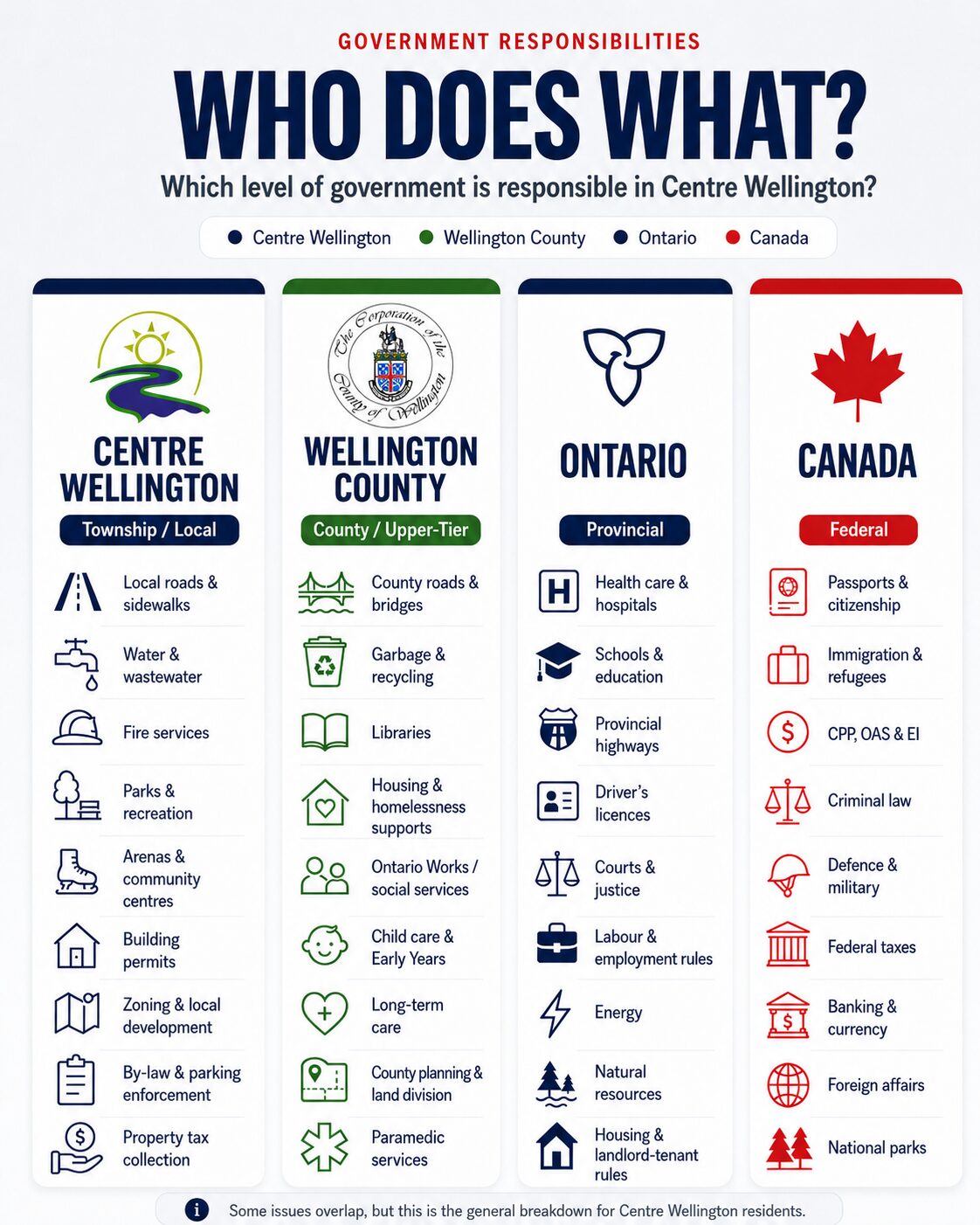
A simplified breakdown of which level of government is generally responsible for common issues affecting Centre Wellington residents.
Some responsibilities overlap, and funding or policy may involve more than one level of government. This guide is meant as a practical starting point.
Responsibilities
Which Government Handles What?
Township / Local Government
Centre Wellington
Centre Wellington council is closest to residents' day-to-day local services. These are the services people often see, use, or contact the Township about directly.
Responsibilities
- Local roads and sidewalks
- Water and wastewater
- Fire services
- Parks and recreation
- Arenas and community centres
- Building permits
- Zoning and local development
- By-law and parking enforcement
- Property tax collection
Common examples
- A pothole on a local street
- A building permit question
- A local zoning or development proposal
- A water or wastewater concern
- Recreation programs or arena facilities
- By-law complaints
- Parking enforcement
Centre Wellington collects property taxes, but the bill includes more than just the Township portion. It can also include County and education portions.
County / Upper-Tier Government
Wellington County
Wellington County is the upper-tier municipal government. It provides services shared across Centre Wellington and other municipalities in the County.
Responsibilities
- County roads and bridges
- Garbage and recycling
- Libraries
- Housing and homelessness supports
- Ontario Works and social services
- Child care and Early Years
- Long-term care
- County planning and land division
- Paramedic services
Common examples
- Garbage or recycling pickup
- Wellington County Library services
- County road concerns
- Social services
- Housing supports
- Paramedic services
- Long-term care services
This is why some issues that feel local are not handled directly by Centre Wellington council.
Provincial Government
Ontario
The Province of Ontario controls many of the major systems residents interact with every day, including health care, education, highways, energy, and landlord-tenant rules.
Responsibilities
- Health care and hospitals
- Provincial education legislation, curriculum, major policy and funding framework
- Provincial highways
- Driver's licences
- Courts and justice
- Labour and employment rules
- Energy
- Natural resources
- Housing and landlord-tenant rules
Common examples
- Hospital wait times
- Family doctor shortages
- School funding
- Driver's licence issues
- Highway 6 concerns
- Landlord and tenant disputes
- Employment standards
Municipal councils can advocate to the province, but they usually do not control these systems directly.
Federal Government
Canada
The federal government handles national and international responsibilities. These issues may affect local residents, but they are not decided by Centre Wellington council.
Responsibilities
- Passports and citizenship
- Immigration and refugees
- CPP, OAS, and EI
- Criminal law
- Defence and military
- Federal taxes
- Banking and currency
- Foreign affairs
- National parks
Common examples
- Passport delays
- Immigration applications
- Employment Insurance
- Canada Pension Plan
- Old Age Security
- Federal income tax
- Criminal law
- Defence
- Banking rules
Local candidates may have opinions on federal issues, but municipal council does not control federal programs.
Common Questions
Common Centre Wellington Questions: Who Handles What?
Here are some common issues residents ask about, and which level of government usually handles them.
Issue
Local street pothole
Usually handled by
Centre Wellington
Issue
County road concern
Usually handled by
Wellington County
Issue
Garbage and recycling pickup
Usually handled by
Wellington County
Issue
Water or wastewater issue
Usually handled by
Centre Wellington
Issue
Building permit
Usually handled by
Centre Wellington
Issue
Zoning or local development
Usually handled by
Centre Wellington, with County/provincial rules involved
Issue
Hospital wait times
Usually handled by
Ontario
Issue
Schools
Usually handled by
Ontario / school boards / school administration
Issue
Libraries
Usually handled by
Wellington County
Issue
Paramedic services
Usually handled by
Wellington County
Issue
Driver's licence
Usually handled by
Ontario
Issue
Passport
Usually handled by
Canada
Issue
Immigration
Usually handled by
Canada
Issue
CPP, OAS, or EI
Usually handled by
Canada
Issue
Landlord-tenant issue
Usually handled by
Ontario
Issue
Property tax bill
Usually handled by
Centre Wellington collects it, but portions go to Township, County, and education
Schools & Education
Shared Responsibilities in Education
School boards are separate public bodies. Trustees are elected during municipal elections, but they are not municipal councillors.
Province of Ontario
Sets provincial curriculum, education legislation, major education policy and the provincial funding framework.
School Board / Trustees
Provide local school-board governance, set strategic priorities and board policy, represent their communities, and oversee board leadership and resources within provincial rules. Trustees make decisions collectively; individual trustees do not have executive authority.
School Administration
Board staff manage the day-to-day operation of the school system. Principals manage individual schools and work with teachers and other staff.
Election Context
Why This Matters During a Municipal Election
During an election, it is fair to ask candidates about local roads, development, taxes, recreation, water, wastewater, by-laws, fire services, parks, and how they will work with Wellington County and the Province of Ontario.
It is also fair to ask candidates how they will advocate on issues like health care, housing, schools, and affordability. But it is important to understand the difference between direct responsibility and advocacy.
Direct Responsibility
Council can make decisions, approve budgets, set policies, or direct local services.
Advocacy
Council can write letters, pass motions, meet with other governments, apply pressure, or support partnerships, but another level of government may hold the main authority.
Candidate Questions
How to Ask Better Candidate Questions
Understanding who does what helps residents ask clearer, fairer, and more useful questions.
Instead of
What will you do about health care?
Ask
Health care is mainly provincial, but what role do you think Centre Wellington council should play in advocating for better local access to care?
Instead of
Why are my taxes so high?
Ask
What parts of the municipal budget do you believe should be prioritized, reduced, or explained more clearly to residents?
Instead of
What will you do about housing?
Ask
Which housing tools are actually available to Centre Wellington council, and how would you use them?
Instead of
What will you do about roads?
Ask
Which local roads, sidewalks, and infrastructure priorities should be addressed first, and how would you balance that with tax pressure?
Ready to learn about the candidates?
Read candidate profiles, compare answers side by side, and follow election updates from Fergus Elora Community News.